

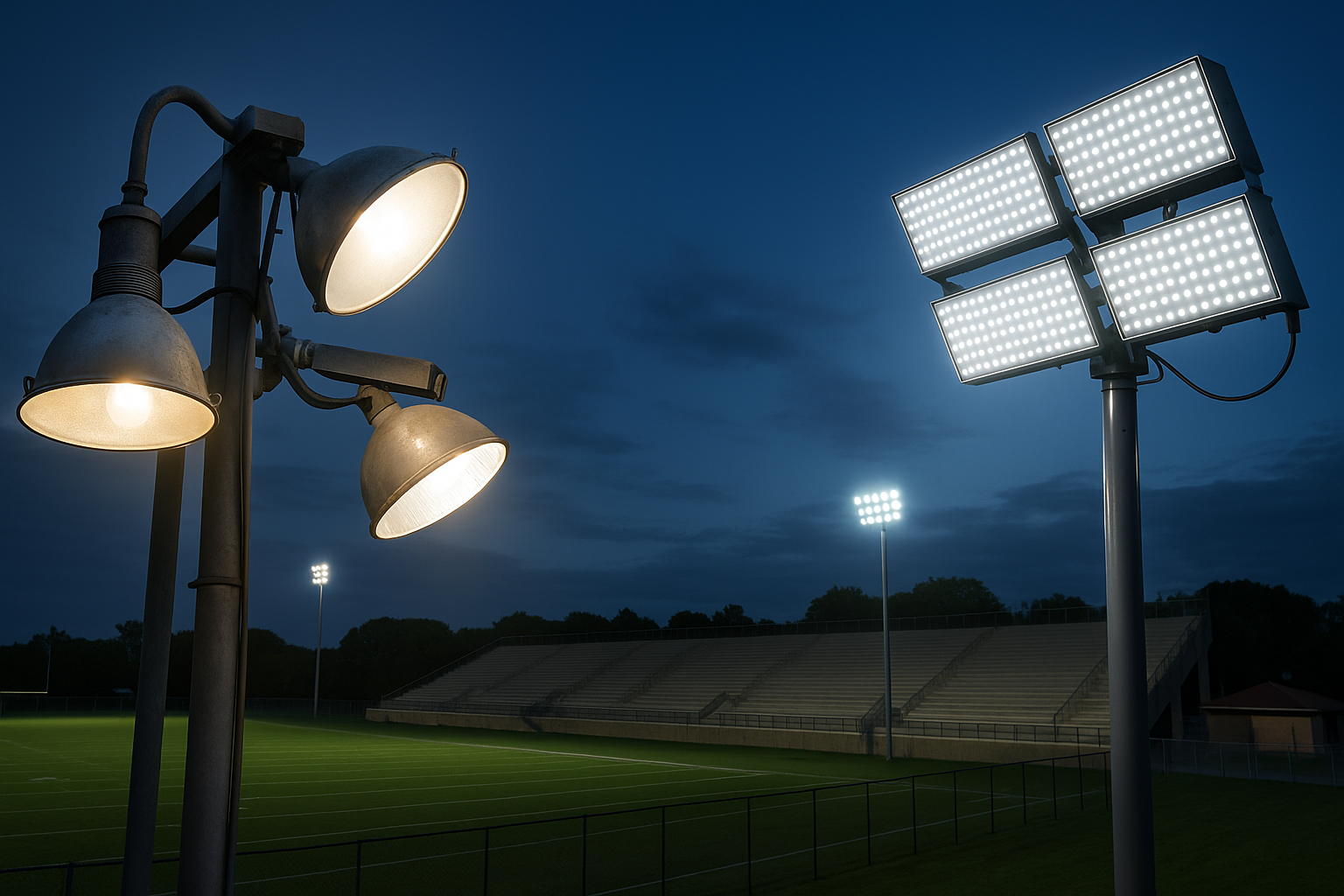
Explore LED Upgrade Options: Compare REITA LED Flood Lights, LED Stadium Lights, LED High Mast Lights, UFO LED High Bay Lights and Industrial LED Lights.
Page Scope: This guide explains the general decision process for upgrading older lighting systems to LED across sports venues, warehouses, ports and industrial facilities. For application-specific fixture selection, layout and photometric design, use the relevant REITA solution or retrofit guide.
Equestrian venues need particular attention to glare, shadows and visual transitions for both riders and horses. For fixture selection, pole layout and project planning, see our horse arena lighting solutions.
If you still rely on metal halide, high-pressure sodium or fluorescent fixtures, you already know their weaknesses: high energy bills, frequent lamp changes, color shift and increasing complaints from users.
Upgrading to LED is no longer just a “nice to have”. For many facilities, it is one of the fastest and most visible investments you can make:
- lower operating cost,
- better visibility and safety,
- less downtime for maintenance.
This guide explains in simple, practical terms why so many stadiums, warehouses, ports and industrial plants are moving to LED – and what you should look at when planning your own upgrade.
1. The Hidden Cost of Keeping Old Lighting Systems

On paper, keeping your existing fixtures seems cheaper: “The lights are still working, why change them?”
In reality, older systems often generate three types of cost:
- High energy consumption – inefficient lamps and ballasts convert a lot of power into heat instead of useful light.
- Maintenance and downtime – lamps fail, ballasts burn out, reflectors get dirty, and every intervention needs man-hours and equipment.
- Risk and reputation – poor lighting can cause accidents, security issues and a bad experience for spectators or workers.
Because these costs are spread out over many small items (utility bills, lift rentals, overtime pay), it is easy to underestimate them.
LED upgrades bundle these savings into one clear project with a measurable payback.
LED Lighting Upgrade Decision Checklist
| Existing Problem | Information to Collect | Possible LED Benefit |
|---|---|---|
| High energy cost | Wattage, quantity, operating hours and electricity rate. | Lower connected load and optional dimming or zoning. |
| Frequent maintenance | Lamp, ballast, labor and lift-rental history. | Fewer planned interventions and reduced downtime. |
| Poor visibility | Lux measurements, dark areas, glare and user complaints. | Improved optics, uniformity and color quality. |
| Old controls | Switching zones, schedules and operational modes. | Dimming, scenes, sensors or intelligent control. |
| Ageing infrastructure | Poles, brackets, wiring, voltage and distribution boards. | A coordinated retrofit can address lighting and electrical risks. |
2. Energy Savings You Can See on Your Utility Bill
LED is dramatically more efficient than traditional sources. For many applications, you can cut power by 40–60% while maintaining or even improving light levels.
2.1 Simple Example
Imagine a small sports field or loading yard with:
- 24 × 1000 W metal halide fixtures
- Operating time: 1,500 hours per year
- Energy price: $0.15 / kWh
Existing system
- Total power: 24 kW
- Annual energy: 24 kW × 1,500 h = 36,000 kWh
- Annual cost: 36,000 × $0.15 = $5,400 / year
LED retrofit
- Replace with 24 × 600–720 W LED flood lights
- Total power ≈ 15–17 kW
- Annual energy ≈ 23,000–25,000 kWh
- Annual cost ≈ $3,450–3,750 / year
Even at conservative numbers, that is roughly $1,600–2,000 per year in pure energy savings – every year, for many years.
If your electricity price is higher or your lights run longer hours (warehouses, indoor arenas, swimming pools), the savings are even more attractive.
3. Maintenance: From Constant Headaches to Planned Inspections
Ask any facility manager what they dislike most about old lighting systems. You will hear the same stories:
- Last-minute lamp failures before an event
- Emergency calls to contractors
- Difficult access to high poles or roof trusses
- Frequent interruptions to operations
3.1 Traditional Systems
Metal halide and fluorescent systems usually require:
- Lamp replacement every 3–4 years (or sooner in harsh environments)
- Ballast replacements and wiring repairs
- Regular cleaning of reflectors and lenses
- Lift rental and safety planning for every intervention
These tasks are time-consuming and unpredictable.
3.2 LED Systems
Quality LED fixtures eliminate many of these issues:
- Long lifetime: 50,000–100,000 hours at L70
- No lamps or ballasts to replace
- Stable lumen output and color over many years
- Maintenance reduced to simple visual inspections and occasional cleaning
Instead of reacting to failures, your team can schedule lighting checks during normal maintenance windows.
4. Better Light Quality: More Useful Light with Fewer Watts
Upgrading to LED is not only about “how many watts you save”. It is also about how much better the light is for the people using the space.
4.1 Higher Quality of Light
LED systems offer:
- Better color rendering (CRI) – colors look natural, making it easier to see markings, tools and safety signs.
- Stable color temperature – no more yellow or green shift as lamps age.
- Instant on / off – full light immediately, no warm-up or restrike time.
For sports venues, this means:
- Players can track the ball more easily.
- Spectators see a clearer, more vivid scene.
- Cameras capture higher quality images without flicker.
For industrial applications, it means:
- Workers can read labels and inspect parts more accurately.
- Operators can notice leaks, damage or unsafe situations earlier.
4.2 Better Optics and Uniformity
Modern LED flood lights, like REITA’s modular series, use precise optics to put light exactly where it is needed:
- On the field, not in the sky
- On the working plane, not into people’s eyes
- On access roads and loading bays, not wasting light on walls
This improves uniformity while often allowing you to use fewer fixtures than before.

5. Control and Flexibility: Dimming, Sensors and Smart Operation
Traditional systems are usually “on or off”. If you don’t need full light, you still pay for it.
With LED, especially when combined with intelligent drivers and controls, you can:
- Dim lights for training, cleaning or low-use periods
- Create scenes: for example “match mode”, “training mode”, “event mode”
- Integrate with motion sensors or timers in warehouses and yards
- Connect to building management systems for central control
Every percentage of dimming translates into additional energy savings and longer lifetime for the fixtures.
6. Safety and Compliance: Meeting Modern Standards
Lighting standards and regulations have evolved. Many older installations no longer meet current requirements for:
- Minimum illuminance levels
- Uniformity
- Glare limitation
- Emergency lighting
Upgrading to LED is an opportunity to bring your facility up to standard:
- Community and school sports fields can align with modern football/soccer lighting guidelines.
- Warehouses and factories can meet occupational health and safety recommendations.
- Ports and yards can improve visibility for vehicles and cranes.
Better lighting reduces the risk of accidents, improves security and supports insurance and compliance requirements.
7. Sustainability and Corporate Image
Energy efficiency is not only about cost.
By reducing your kWh consumption, you also cut CO₂ emissions. Many municipalities, sports clubs and companies now have clear sustainability goals:
- CO₂ reduction targets
- “Green facility” labels
- ESG reporting requirements
LED upgrades are one of the most visible and easily documented actions:
- You can compare energy bills before and after the project.
- You can communicate real numbers to sponsors, members and the community.
- Bright, modern lighting makes your facility look more professional and welcoming.
8. Typical Payback Periods and How to Calculate Yours
For most projects, LED upgrades pay for themselves in a few years through energy and maintenance savings.
8.1 Typical Ranges
- Small community fields or gymnasiums: 3–6 years
- Larger stadiums or facilities with long operating hours: often 2–4 years
- High-temperature or hard-to-reach areas with high maintenance cost: payback can be even faster.
8.2 Simple Payback Formula
You don’t need complicated finance models to get a first idea.
- Calculate your current annual cost (energy + typical maintenance).
- Estimate your future annual cost with LED.
- Subtract to get annual savings.
- Divide your total project cost by the annual savings:
Payback (years) = Total project cost ÷ Annual savings
For a deeper dive into running cost and ROI calculations, you can look at a dedicated Stadium Lights Cost & ROI Calculator and adapt the principles to your own site.

9. Where LED Upgrades Make the Biggest Difference
While almost any application can benefit from LED, some areas show particularly strong results.
9.1 Sports Fields and Stadiums
- High power levels and long evening hours
- Strict requirements for uniformity and glare
- Difficult access to poles and high masts
LED flood lights with the right optics can significantly reduce power and maintenance while improving playability and spectator experience.
Case Study: FIFA Beach Soccer World Cup 2021, Moscow
A good example of how an LED upgrade transforms a sports venue is the FIFA Beach Soccer World Cup 2021 in Moscow, Russia.
For this temporary beach soccer stadium, REITA supplied LED stadium floodlights to deliver:
- Bright, uniform illumination across the full sand pitch
- Comfortable visibility for players, referees and spectators
- Reliable, flicker-free performance for international TV broadcast
The compact arena was surrounded by grandstands on all four sides, so the lighting design had to control glare carefully while still meeting FIFA’s broadcast and safety requirements.
The result was a bright, TV-ready venue with excellent atmosphere for night matches, and a system that could be installed and removed efficiently for the tournament.
*(Insert project photo here as the main image or inside this section.)

9.2 Warehouses and Industrial Halls
- Long operating hours, sometimes 24/7
- Need for clear visibility of racks, pallets and machinery
- Often poor lighting with old high-bay fixtures
High-efficiency LED high bays or modular flood lights create a brighter, safer workspace with lower operating cost.
9.3 Ports, Yards and Outdoor Work Areas
- Very tall poles and large open areas
- Exposure to wind, dust, rain and sometimes salt air
- High maintenance cost due to equipment and safety planning
Robust IP66 LED flood lights with precise optics allow you to reduce fixture count, improve uniformity and cut energy bills.
9.4 High-Temperature and Harsh Environments
Foundries, steel mills, glass factories and other hot areas are especially hard on traditional lamps.
LED systems designed for high ambient temperature can:
- Survive where standard fixtures fail
- Reduce dangerous dark spots
- Lower heat load compared with inefficient lamps
9.5 Swimming Pools and Natatoriums
Pools combine humidity, chemicals and complex reflection conditions.
Upgrading to LED improves:
- Visibility below the water line
- Glare control for lifeguards and swimmers
- Long-term durability in chlorinated or salty air
10. How to Plan a Successful LED Upgrade with REITA

A good LED upgrade is not just a 1:1 lamp replacement. It is a small engineering project that deserves proper planning.
10.1 Step 1 – Collect Basic Data
- Area dimensions and layout
- Existing fixture types, wattages and positions
- Typical operating hours and electricity tariff
- Known problem areas (dark corners, glare, maintenance issues)
10.2 Step 2 – Request a Lighting Design and Proposal
Work with a specialist manufacturer who can provide:
- AGi32 / Dialux lighting simulations
- Product selection based on your application (sports field, port, warehouse, high temp, pool)
- Clear performance data: lumen output, beam angles, CRI, CCT, IP rating, lifetime
10.3 Step 3 – Review ROI and Phasing Options
For some sites, it makes sense to upgrade everything at once.
For others, you might:
- Start with the worst-performing area
- Upgrade one field, one hall or one yard as a pilot project
- Use the improved performance and lower bills to justify the next phase
10.4 Step 4 – Install, Aim and Verify
Proper installation and aiming are crucial. After commissioning:
- Verify illuminance and uniformity
- Check control functions (dimming scenes, sensors, timers)
- Set a simple maintenance schedule for visual inspections
With these steps, your LED upgrade becomes a long-term asset, not just a product purchase.
FAQ: Common Questions About Upgrading to LED
1) Do I need to replace poles or building structures when upgrading to LED?
Not always. In many projects, existing poles and mounting points can be reused.
Because LED fixtures are often lighter than the old luminaires, structural loading is usually not a problem. However, very old or corroded structures should always be checked by an engineer.
2) Will LED create more glare or light pollution?
It depends on the design. Poorly chosen or aimed fixtures can create glare, just like any other system.
A professional design using correct beam angles and tilting will usually reduce glare and spill light compared with old flood lights.
3) Are LED systems completely maintenance-free?
No system is truly maintenance-free, but LED dramatically reduces maintenance needs.
You should still plan simple inspections, cleaning and driver checks. Compared with regular lamp and ballast replacements, this is much lighter work.
4) Can I upgrade gradually, or must I change everything at once?
You can do either. Some facilities prefer a full upgrade; others start with:
- One field
- One production hall
- One parking area
This allows you to test the technology, gather feedback and demonstrate savings before investing in the remaining areas.
5) How do I choose the right LED supplier?
Look for a partner who can offer:
- Proven experience in sports and industrial lighting
- Real project references and photos
- Detailed lighting designs and ROI analysis
- Clear warranties and after-sales support
This combination is more important than the cheapest fixture price on paper.
Next Step – Explore an LED Upgrade for Your Facility
If you are considering an upgrade, you don’t have to guess.
Share with us:
- Your current lighting layout and fixture types
- Basic drawings or photos of the site
- Typical operating hours and energy cost
REITA can help you prepare a lighting design and simple ROI estimate so you can see the benefits clearly before making a decision.
With a well-planned LED upgrade, you gain brighter, safer and more efficient facilities – and a lighting system that will support your operations for many years.
Related LED Retrofit and ROI Resources
- How LED Lighting Pays for Itself
- Sports Venue LED Retrofit Guide
- LED Stadium Lights vs Metal Halide
- Supplier Documentation Checklist
- Contact REITA
Planning an LED Lighting Upgrade?
Send REITA your existing fixture type, wattage, quantity, operating hours, electricity rate, mounting height, target lux and site photos. We can recommend suitable LED fixtures and estimate the energy-saving and retrofit direction.Request an LED Upgrade Proposal