

For large pool halls and facilities requiring high-output directional lighting, explore REITA’s professional LED flood lights with project-specific optics and photometric support.
Swimming pools are one of the most demanding environments for lighting.
You have water reflections, moisture, chemicals, slippery walkways and people moving fast – sometimes diving head-first. Good lighting is not just a matter of aesthetics. It directly affects safety, comfort and operating cost.
In the past, most indoor pools and natatoriums used metal halide or fluorescent fixtures. Today, professional facilities – from hotel pools to Olympic venues – are moving to LED. Not only because LED is “new technology”, but because it solves a long list of practical problems that old systems could never fully handle.
This article explains in clear, non-marketing language why LED lighting is the best long-term solution for swimming pools, and what you should pay attention to when selecting fixtures for your next project.
1.What Do Swimming Pools Really Need from Their Lighting?
Before comparing technologies, it helps to look at what a typical pool actually needs.
A good pool lighting system should:
- Provide safe visibility for swimmers, lifeguards and staff – you must see bodies and lane lines clearly under all conditions.
- Offer comfortable, glare-controlled light – no harsh reflections off the water that make it hard to keep eyes open.
- Work reliably in a humid, corrosive environment – chlorinated or salty air, condensation and high temperatures near the ceiling.
- Be easy to maintain – no frequent lamp changes or complicated access with scaffolding or lifts.
- Keep operating costs under control – energy bills and maintenance time quickly add up when lights run many hours a day.
Metal halide and fluorescent fixtures can cover some of these needs, but they struggle with others. LED, when properly designed, addresses all of them in one package.
2.Energy Efficiency: Why LED Instantly Cuts Pool Operating Cost
Swimming pools often operate long hours:
- Early morning lane swimming
- Daytime training or school groups
- Evening public sessions and classes
It is not unusual for pool lights to run 10–16 hours per day, almost every day of the week. That makes energy efficiency a critical factor.
2.1 Wattage Comparison
Traditional systems:
- Metal halide high-bay fixtures above the pool: typically 250–400 W per fixture
- Fluorescent fixtures along the deck and spectator areas: 2×58 W or similar
LED pool lights from REITA can deliver the same or better illuminance with:
- 120–200 W LED flood lights replacing 250–400 W metal halide
- Linear LED fixtures replacing fluorescent rows at roughly half the wattage
A typical indoor 25 m pool might use 20–30 fixtures. Saving 100–200 W per fixture quickly turns into thousands of kWh per year.
2.2 Real-World Saving
If your current system consumes 10 kW and runs 12 hours a day:
- Annual operating hours: 12 h × 365 ≈ 4,380 h
- Annual energy: 10 kW × 4,380 h = 43,800 kWh
If an LED solution cuts power to 5.5 kW:
- Annual energy: 5.5 kW × 4,380 h ≈ 24,090 kWh
At $0.15 / kWh, that is roughly:
- Old system: ≈ $6,570 / year
- LED system: ≈ $3,613 / year
- Energy saving: ≈ $2,900 / year – just for one pool
This does not include maintenance, which is where LED creates even more long-term value.
3.Comfort and Safety: Seeing Below the Water Line
One of the biggest advantages of LED is its ability to provide clean, uniform light with very good color rendering. For swimming pools, this translates directly into safety.
3.1 Uniformity and Vertical Illuminance
Metal halide fixtures tend to create bright spots and dark gaps. The water surface looks patchy, and objects below the surface are not always visible.
LED flood lights with carefully designed optics can:
- Deliver high vertical illuminance so lifeguards can see faces and bodies clearly.
- Maintain good uniformity across all lanes and the deep end.
- Reduce shadow areas around diving boards and ladders.
This is especially important for competitions and training, where coaches and officials need to follow swimmers at all times.
3.2 Color Temperature and CRI
The typical choice for indoor pools is:
- CCT: 4000–5000 K (neutral to cool white)
- CRI: ≥ 80, ideally ≥ 90 for TV or high-end facilities
LED makes it easy to achieve and maintain these values.
Water appears clean and inviting, lane lines and flags are clearly distinguished, and skin tones look natural – all contributing to a more pleasant environment.

4.Glare Control and Reflections: The LED Advantage
Ask any lifeguard or swimmer: glare is one of the most annoying problems in a pool hall.
Bright ceiling fixtures can reflect off the water surface directly into people’s eyes.
4.1 Why Older Systems Glare More
Metal halide fixtures with simple reflectors emit light in all directions.
A lot of this light hits the water at shallow angles and bounces straight back toward spectators and lifeguards.
Fluorescent rows also create long lines of reflection on the surface. When combined, these can create a “mirror of light” that makes it hard to see below the surface.
4.2 How LED Helps
With LED, we can:
- Use narrower, controlled beam angles to direct most of the light to the water and deck, not to the eyes.
- Tilt fixtures in a way that reduces reflected glare on the lifeguard platforms.
- Employ special diffusers or secondary optics to soften brightness without losing efficiency.
Proper design and aiming mean swimmers can keep their eyes on the wall and turn safely, while lifeguards can scan the entire pool without squinting.
5.Built for Harsh Environments: Moisture, Chlorine and Heat
Pools are hard on fixtures:
- Constant humidity and condensation near the ceiling
- Air filled with chlorine or salt, which is highly corrosive
- Higher temperature under the roof due to warm water and poor ventilation in some buildings
Cheap or unsuitable fixtures will quickly show rust, peeling paint, discolored lenses or even early failure.
5.1 Protection Ratings You Should Look For
When choosing LED fixtures for a pool, you should always check:
- IP rating: IP65 or IP66 is recommended to keep out moisture and dust.
- Corrosion-resistant housing: powder-coated aluminum with proper surface treatment.
- Stainless steel screws and brackets: ideally 304 or 316 grade in aggressive environments.
- High-quality gaskets and seals: to prevent long-term water ingress.
5.2 Thermal Management
LEDs and drivers are sensitive to high temperature. A well-designed pool fixture will:
- Have large heat sinks to dissipate heat effectively.
- Use drivers rated for high ambient temperature.
- Place sensitive components away from the hottest zones where possible.
REITA’s high-power LED flood lights and high-bay solutions are based on our experience with stadiums, high-temperature factories and outdoor ports, which makes them naturally robust for swimming pool environments as well.
6.Maintenance: Why LEDs Are a Relief for Facility Managers
Changing lamps above a pool is not fun.
Often you need:
- A special lift that can reach over the water
- To drain the pool or build temporary scaffolding for safe access
- Extra staff and time to coordinate the operation
This means every lamp failure turns into a mini-project.
6.1 Longer Lifetime, Fewer Interventions
LED fixtures with quality drivers and thermal design can offer:
- 50,000–100,000 hours of lifetime
- Much slower lumen depreciation than metal halide or fluorescent systems
For a pool running 4,000 hours per year, that is:
- Roughly 12–25 years of operation before reaching 70% of initial lumen output.
You still need simple periodic inspections, but there are no regular lamp or ballast changes. Maintenance becomes predictable and minimal, freeing your staff to focus on water treatment and visitor experience.
6.2 Lower Risk of Sudden Failures
Metal halide lamps can fail or flicker without warning. If that happens during opening hours, you may need to close part of the pool or even cancel a session.
Reliable LED systems with surge protection significantly reduce the risk of unexpected outages.
If a driver does fail, it can usually be replaced during planned maintenance, not emergency call-outs.

7.Flexibility and Control: Dimming, Scenes and Instant On/Off
Another advantage of LED is the ability to control light output smoothly.
7.1 Instant On / Off
Metal halide requires warm-up and restrike time. After switching off, you may wait several minutes before you can safely restart the lamps.
LED, by contrast, is:
- Instant on – full light immediately
- Instant off – no cooling or restrike delay
This makes it easy to switch light levels between:
- Cleaning
- Training
- Competition
- Public sessions
without worrying about cooling times.
7.2 Dimming and Lighting Scenes
Most professional LED drivers can be integrated with:
- 0–10 V or DALI dimming
- Simple wall panels or advanced building management systems
This allows you to create lighting scenes:
- Lower light for general public swimming
- Higher light for training or matches
- Accent lighting for events or parties
By dimming when full output is not needed, you extend fixture life even further and save additional energy.

8.Key Design Tips for a Successful LED Pool Project
Choosing LED is only half of the story. To really benefit from the technology, you should:
- Start with a lighting design
– Use professional software (AGi32, Dialux) to model the pool, deck and spectator areas.
– Check horizontal and vertical illuminance, uniformity and glare. - Select the right optics and mounting positions
– Narrower beams for high ceiling mounting.
– Wider beams for low ceilings or decks.
– Avoid direct sight lines from swimmers to LED chips. - Consider maintenance access
– Group fixtures in accessible zones.
– Use robust brackets and simple aiming devices. - Pay attention to color and comfort
– For most indoor pools, 4000–5000 K, CRI ≥ 80 is a safe choice.
– For TV broadcast or high-end venues, consider CRI ≥ 90. - Work with a manufacturer who understands harsh environments
– Ask for IES files, simulation reports, IP and corrosion test data and warranty conditions.
– Look for real project references, not only spec sheets.
9.Case Study: World Games Competition Pool in Wrocław,Poland
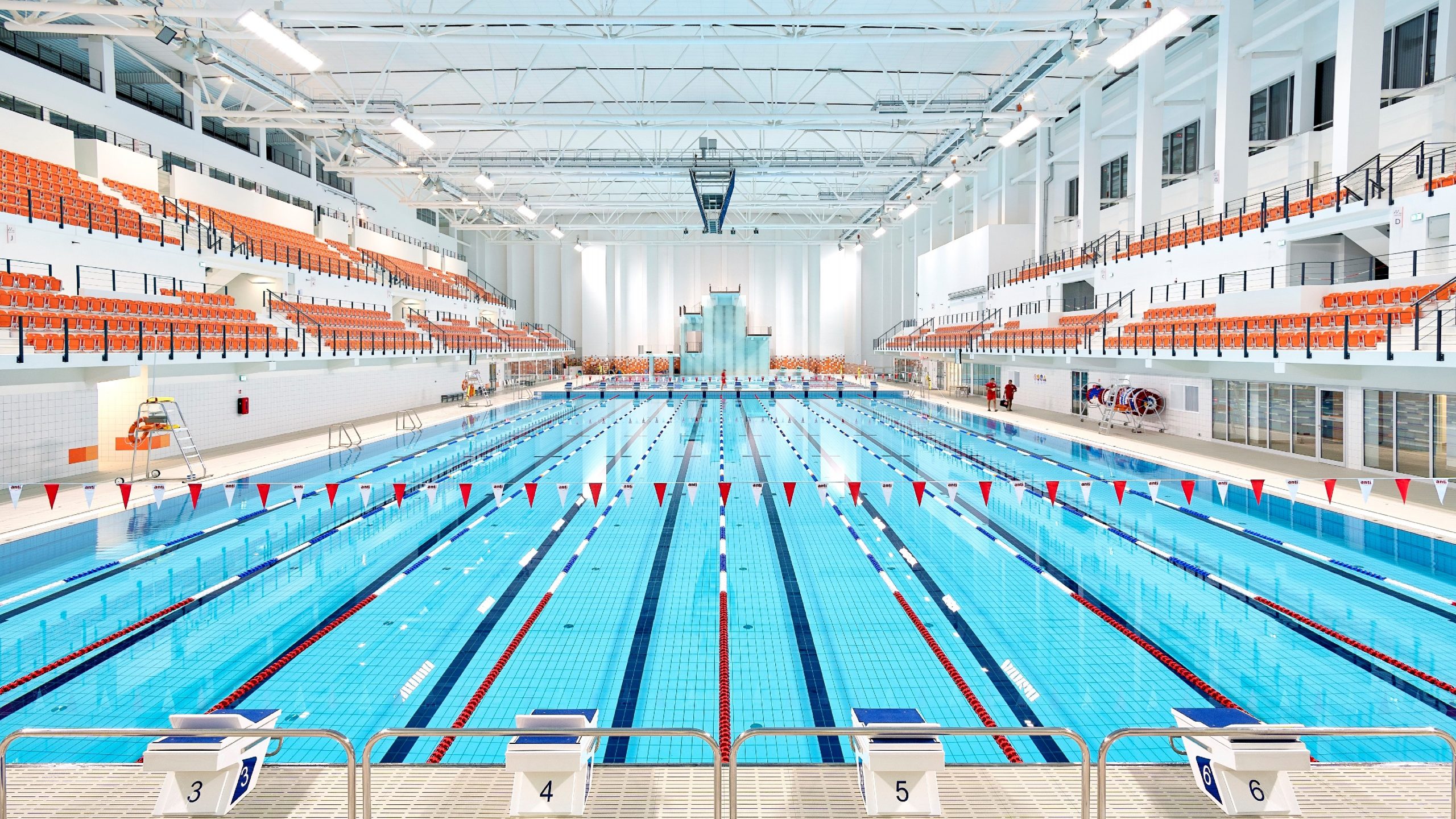
A good example of how modern LED lighting performs in a demanding pool environment is the competition venue for The 10th World Games 2017 in Wrocław, Poland.
For this project, REITA supplied 720W modular LED flood lights mounted high above the pool on the main steel trusses. The venue needed lighting that was:
- Bright and uniform enough for international-level competition
- Flicker-free for TV cameras and slow-motion replay
- Reliable under constant humidity and chlorinated air
- Easy to maintain despite very difficult access high above the water
9.1 Project Challenges
- The pool hall is large, with high ceilings and long viewing distances from the stands.
- Fixtures are mounted on the roof structure, which means every maintenance visit requires special equipment.
- The lighting had to meet strict requirements for horizontal and vertical illuminance so athletes, lane markings and water surface were clearly visible from all angles.
- During the Games the venue operated for long hours every day, so energy consumption and heat management were also important.
9.2 LED Solution
To meet these requirements, REITA designed a system based on:
- 720W high-efficiency LED flood lights with narrow to medium beam optics
- Robust, IP66-rated housings with corrosion-resistant materials
- Flicker-free drivers suitable for broadcast-grade sports lighting
- Carefully calculated aiming angles to minimise glare for swimmers, referees and spectators
The long modular fixtures you see in the photos are suspended from the steel beams and aimed toward the pool and spectator areas.
Instead of many smaller lamps, each 720W unit delivers a high lumen package with precise optical control, reducing the total number of fixtures while maintaining excellent uniformity.
9.3 Results and Benefits
During the World Games, the lighting system delivered:
- Bright, even illumination across the entire competition pool and warm-up areas
- Comfortable visibility for athletes and officials, with no disturbing reflections on the water surface
- Stable color and flicker-free performance for cameras and international broadcast
- Minimal maintenance needs thanks to durable construction and long LED lifetime
For the venue operator, the switch to LED also means lower long-term running cost compared with traditional metal halide solutions, and a system that will continue to support future events with minimal disruption.
This project shows how a well-designed LED system can handle the toughest combination of humidity, height, long operating hours and international competition standards – exactly the type of environment where LED is the perfect solution for swimming pools.

10.FAQ: LED Lighting for Swimming Pools
1) Can I reuse my existing light positions when upgrading to LED?
In many cases, yes. If the existing layout works reasonably well, LED fixtures with proper optics can be mounted in the same locations and aimed correctly. However, a lighting simulation should always confirm that illuminance and uniformity meet your current standards.
2) Is it safe to use LED lights directly above the water?
Yes, as long as the fixtures are designed for pool environments:
- Adequate IP rating (IP65 or IP66)
- Double insulation or proper earthing
- Compliance with local electrical codes
Always have a qualified electrician install and test the system.
3) What color temperature is best for indoor pools?
Most facilities choose 4000 K for a natural, comfortable white, or 5000 K for a slightly crisper look. Very warm light (3000 K) tends to make water look dull, while very cool light (>5700 K) can feel harsh.
4) Do LED lights flicker and affect swimmers or cameras?
High-quality LED pool lights are designed to be flicker-free, even at high-speed camera frame rates. This is important for competitions, TV broadcasting and slow-motion video. Make sure your supplier can confirm flicker performance and provide sample testing if necessary.
5) How long is the typical payback for an LED pool lighting upgrade?
It depends on running hours, electricity price and the condition of the existing system. For a busy indoor pool with high electricity rates and frequent lamp replacements, payback periods of 3–6 years are common. After that, the energy and maintenance savings are effectively profit.
11. Why Choose REITA LED Lighting for Your Pool Project?
As a manufacturer specialising in high-power sports and industrial LED fixtures, REITA combines:
- Experience with stadiums, ports, high-temperature factories and outdoor courts
- Robust, IP66-rated housings with corrosion-resistant materials
- Carefully designed optics and flicker-free drivers
- Complete support with lighting design, product selection and ROI analysis
Whether you are upgrading an existing community pool or designing a new competition venue, we can help you select the right combination of LED flood lights and high-bay fixtures to meet your safety, comfort and efficiency goals.
Next Step – Request a Free Pool Lighting Proposal
If you would like to see what LED could do for your pool:
- Send us the length, width and depth of your pool
- Provide a simple sketch of the building and current light positions
- Share your typical operating hours and electricity cost
We will prepare a free lighting layout and product proposal, and—if you wish—combine it with a simple running cost and ROI estimate based on your real numbers.
With a clear design and financial picture, you can upgrade with confidence and enjoy safe, bright and energy-efficient swimming for many years.
Need Help With a Stadium Lighting Project?
Send REITA your field size, pole height, required lux level, voltage and installation photos. We can help recommend suitable stadium lights, beam angles and fixture quantities for your project.
Contact REITA for Stadium Lighting Support
