

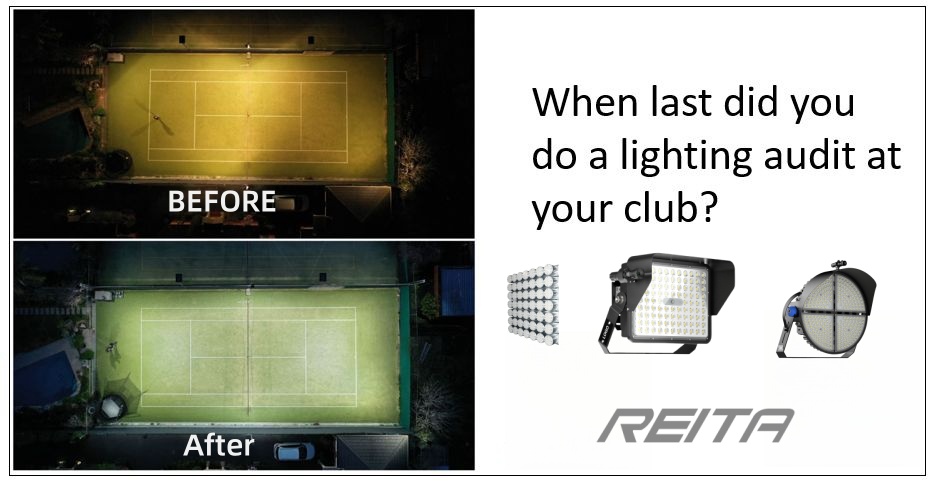
Rooftop football and padel courts are becoming very popular in dense cities.
They make use of limited space, offer great views, and keep sports facilities close to where people live and work.
But for lighting designers and contractors, rooftop projects are much more sensitive than ground-level fields:
- The courts are very close to residential windows and offices.
- Any light spill is immediately visible in the city skyline.
- Structural loads, wind and access for maintenance are more difficult.
In this article we focus on what matters most for rooftop football and padel courts:
- Controlling spill light and glare
- Avoiding neighbour complaints
- Using shields, optics and smart layouts to keep light on the court, not in the neighbours’ bedrooms.

1. Understand the rooftop constraints first
Before choosing fixtures, take time to map the constraints that do not exist on a normal ground field.
1. Surrounding buildings and neighbours
- How far are the nearest residential windows? 10 m? 30 m?
- Are there offices or hotels at similar height to the court?
- Which directions are most sensitive (e.g. luxury apartments, main street)?
2. Building structure and parapet
- What is the height and thickness of the parapet or safety fence?
- Can poles be fixed behind the parapet, or must they be on the inside?
- What maximum height and wind load does the structure allow?
3. Access and safety
- How will installers and maintenance staff reach the luminaires?
- Is there safe access for aiming and replacement?
- Are there restrictions on crane use, scaffolding or cherry pickers?
A simple site sketch with court, parapet and neighbouring buildings is extremely useful. It allows you to plan light distribution and shielding before you open any software.
If you need a general introduction to stadium lighting components and optics, you can start with our Stadium Lighting 101 guide.
2. Typical lighting levels for rooftop football and padel courts
Exact values depend on standards (EN 12193 or local codes) and the level of play, but the following ranges are common:
5-a-side / rooftop football courts
- Training / recreational play: 75–200 lux average
- Amateur competition / commercial leagues: 200–300 lux
- Uniformity (Emin / Eavg): 0.5–0.7
Padel courts
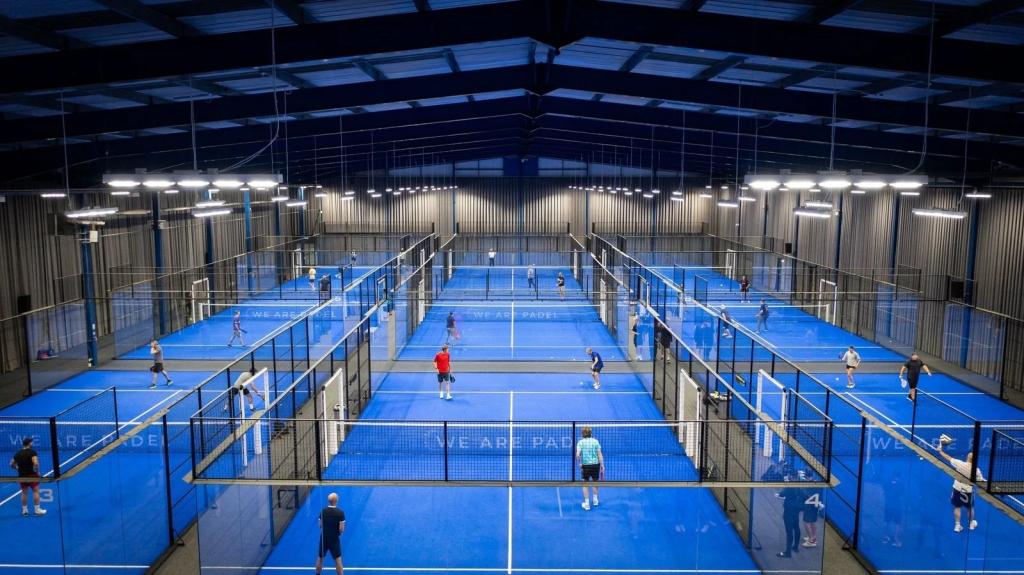
- Training / rental courts: 200–300 lux
- Club / competition level: 300–500 lux
- Very good vertical illuminance and uniformity are important because the ball travels high and fast against dark backgrounds.
For rooftop projects, more light is not always better. It is usually wiser to design for the lower end of the recommended range and keep glare and spill light strictly under control.
3. Main risks: spill light, glare and neighbour complaints
Rooftop courts are often surrounded by neighbours at the same eye level as the luminaires. This creates three immediate risks:
- Direct view into LED arrays
Residents and office workers see the bare LED chips across the court; the luminance is very high and uncomfortable. - High vertical illuminance on façades
Light hits windows and balconies directly, causing rooms to be bright even with curtains. - Light above the horizon (sky glow)
Wide beams going upward make the building look like a lighthouse and may conflict with local “dark sky” or obtrusive light limits.
For a deeper technical discussion of glare sources and control methods, please refer to our guide on glare in LED stadium lighting projects.
If these issues are not addressed at design stage, you will have:
- Complaints to building management and local authorities
- Pressure to switch off or dim the system so much that the court becomes unusable
- Additional retrofit cost (extra shields, re-aiming, even new poles)
The rest of this guide focuses on how to avoid these problems.
4. Pole layout strategies on rooftops
Often you cannot choose pole positions freely on a roof, but you still have some design options.
4.1 Place poles behind parapets or fences where possible
If the structure allows, fix poles behind the parapet instead of on the court edge:
- The parapet or safety fence acts as a natural shield, hiding the LED arrays from many neighbour viewing angles.
- You can raise the luminaires slightly higher without increasing glare.
Even a 1.2–1.5 m parapet can cut a lot of direct light towards nearby windows.
4.2 Use higher poles with tighter beams – not low poles with wide beams
A common mistake is to use low poles (6–8 m) with 90° floods very close to the court. For rooftop environments this is usually the worst possible choice:
- Players and neighbours see the luminaires almost head-on.
- A lot of light goes above the horizon and into windows.
Whenever the structure allows, consider:
- Higher poles (10–12 m for football, 8–10 m for padel)
- Combined with narrower optics (30–60°)
This keeps most light on the court and reduces upward spill.
4.3 Cross-aim from less sensitive sides
If one side of the building faces apartments and the other faces a commercial street, use cross-aiming:
- Put more luminaires on the “less sensitive” side and aim them across the court.
- Reduce the number and output of luminaires on the residential side and shield them more aggressively.
This simple strategy can dramatically reduce complaints.
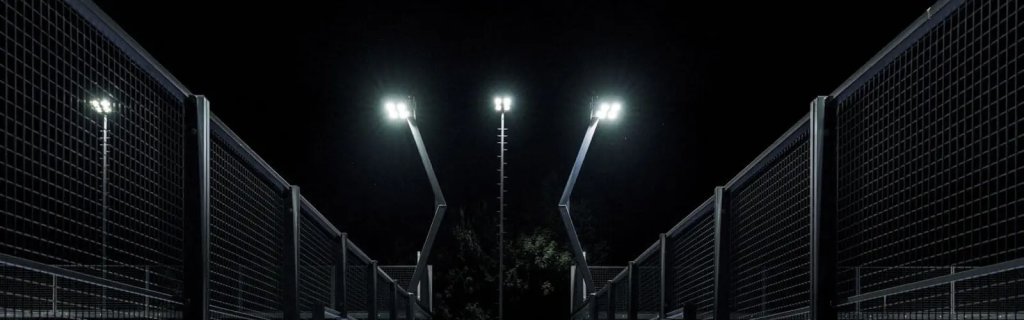
5. Choosing optics and shields for urban rooftops
Fixtures for rooftop courts should give you fine control over light distribution.
Because rooftop luminaires are fully exposed to wind, rain and pollution, make sure the fixtures have suitable IP and IK ratings for long-term outdoor use.
5.1 Optics: asymmetric and cut-off beams
Look for luminaires that offer:
- Narrow and medium beams (e.g. 30°, 45°, 60°) for distance control
- Asymmetric optics that push more light downwards and towards the court, with a sharp cut-off behind the mast
- Good vertical illuminance on players without spraying light into the sky
For example:
- On a rooftop football court, use narrower beams for the far half of the court and medium beams for areas closer to each mast.
- On padel courts, use asymmetric beams placed outside the glass walls, aiming inwards at a shallow angle.
Avoid using 90° “flood” optics on high poles at roof level unless they are fully shielded and aimed very carefully.
5.2 Shields, visors and screens
Mechanical shielding is essential in dense urban roofs.
Options include:
- Top visors to block light going above the horizontal plane.
- Side visors on luminaires facing residential windows.
- Rear shields for fixtures installed near building edges.
- External screens or black mesh attached to perimeter fences to block direct view of the LED arrays.
Best practice:
- Identify which luminaires are visible from the most sensitive neighbours.
- Use the strongest shielding on those luminaires.
- Combine shields with tighter optics rather than relying on shields alone.
In some projects, a 1–2 m extension of the fence with dark mesh can be the most cost-effective way to hide the luminaires from windows that are very close.
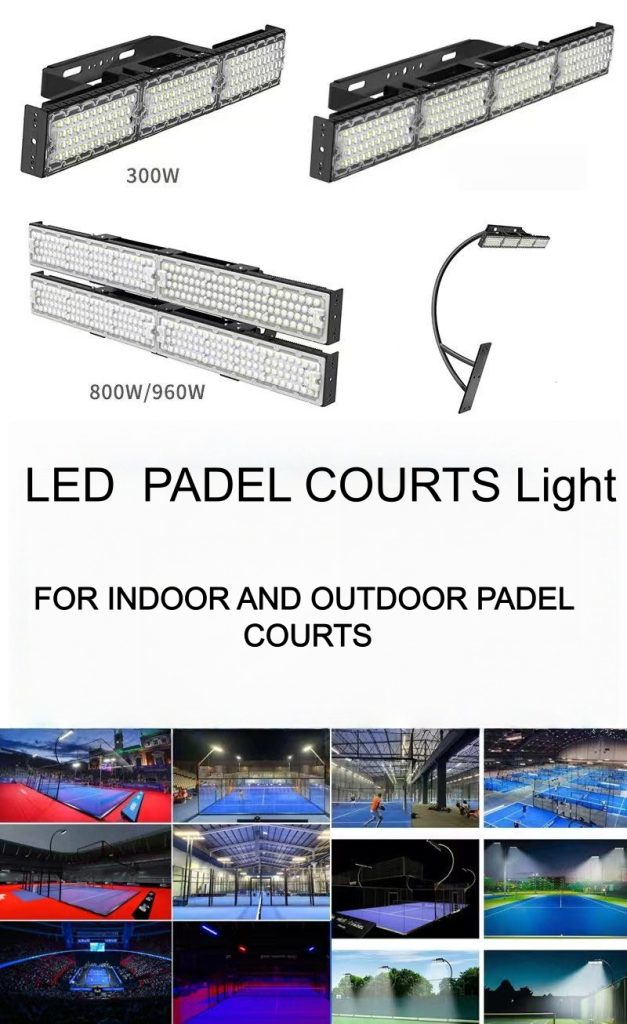
6. Special notes for padel courts
Padel courts have specific characteristics:
- Small size: 20 × 10 m
- Glass or mesh walls that can reflect and scatter light
- Ball trajectory is high; players often look up towards the luminaires
Design tips:
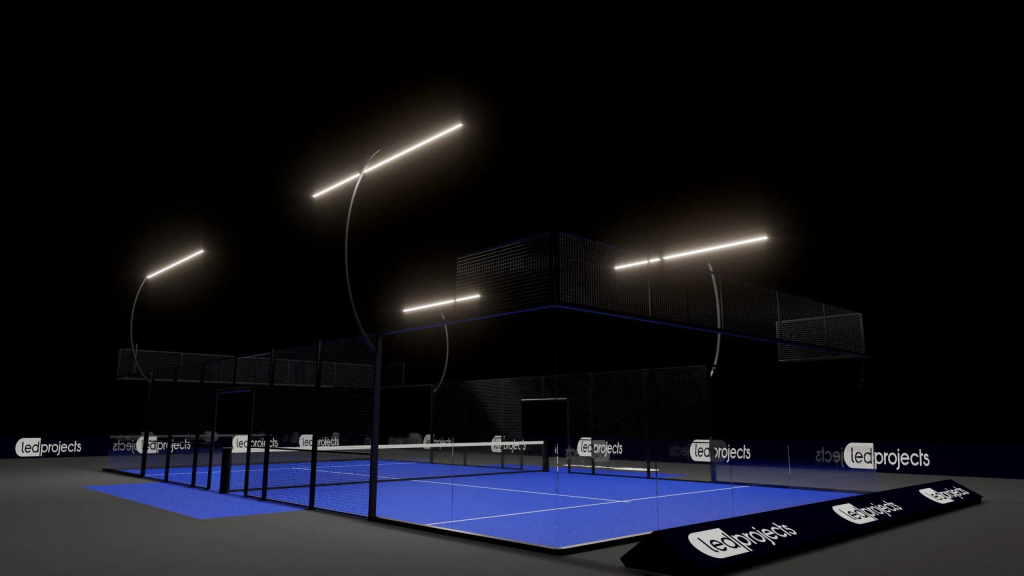
- Pole positions
- Common layouts use 4 or 8 poles at 6–8 m height, placed outside the long sides.
- For rooftop projects, consider a slightly higher mounting (8–9 m) with tighter beams to reduce glare.
- Aiming
- Avoid placing luminaires directly above the players’ typical viewing direction (e.g. behind the baseline at low height).
- Aim fixtures so that the beam center hits the back third of the court rather than straight down near the pole.
- Glare control
- Use asymmetric or double-asymmetric optics to keep the brightest part of the beam off the eyes.
- Add visors on luminaires that have line-of-sight to nearby balconies.
Because padel balls are small and fast, many operators push for very high lux levels (500+). On rooftop courts it is often better to stay around 300–400 lux with excellent uniformity and good glare control instead of chasing extreme values.
7. Controls, schedules and complaints prevention
Even the best optical design can be undermined if the lights are on all night.
You can reduce risk of complaints by planning:
- Time schedules
- Lights automatically switch off at a fixed time (e.g. 22:00 or 23:00).
- For late bookings, use manual override with a clear cut-off.
- Scene dimming
- Training mode at 60–70% power.
- Match mode at 100% only when needed.
- Cleaning / standby mode at 30% while staff close the facility.
- Zoning
- Separate circuits for different courts or halves of a court so that unused areas can be dimmed or turned off.
Explain these measures in your proposal; it shows building managers and residents that you take community impact seriously.
On exposed rooftops, you should also pay attention to surge protection levels for your drivers and distribution boards, as lightning and switching surges can be more severe. Our surge protection guide for LED stadium and sports lighting explains typical 10 kV and 20 kV solutions in detail.
8. A rooftop sports lighting design workflow
When you receive a new rooftop project, you can follow this step-by-step workflow:
- Collect information
- Roof plan with parapet heights
- Court layout and type (football / padel)
- Photos or sketches of surrounding buildings and key neighbour directions
- Define lighting targets
- Lux levels and uniformity for each court
- Any local limits on vertical illuminance or upward light ratio (ULR)
- Draft pole layout
- Prefer poles behind parapets or fences
- Use higher poles with tighter beams where structure allows
- Plan cross-aiming from the less sensitive sides
- Select optics and shields
- Choose a mix of narrow/medium/asymmetric beams
- Add visors / louvres on luminaires facing neighbours
- Run AGi32 / Dialux calculations
- Check horizontal and vertical illuminance on the courts
- Add calculation planes on nearby façades to see spill light
- Review 3D views from neighbour windows and streets
- Fine-tune and document
- Adjust aiming and shielding where levels or glare are high
- Prepare aiming diagrams and a short note explaining spill-light control, schedules and shields.
By following this process, you can deliver rooftop football and padel courts that are bright and safe for players but still friendly to neighbours and the city skyline.
