

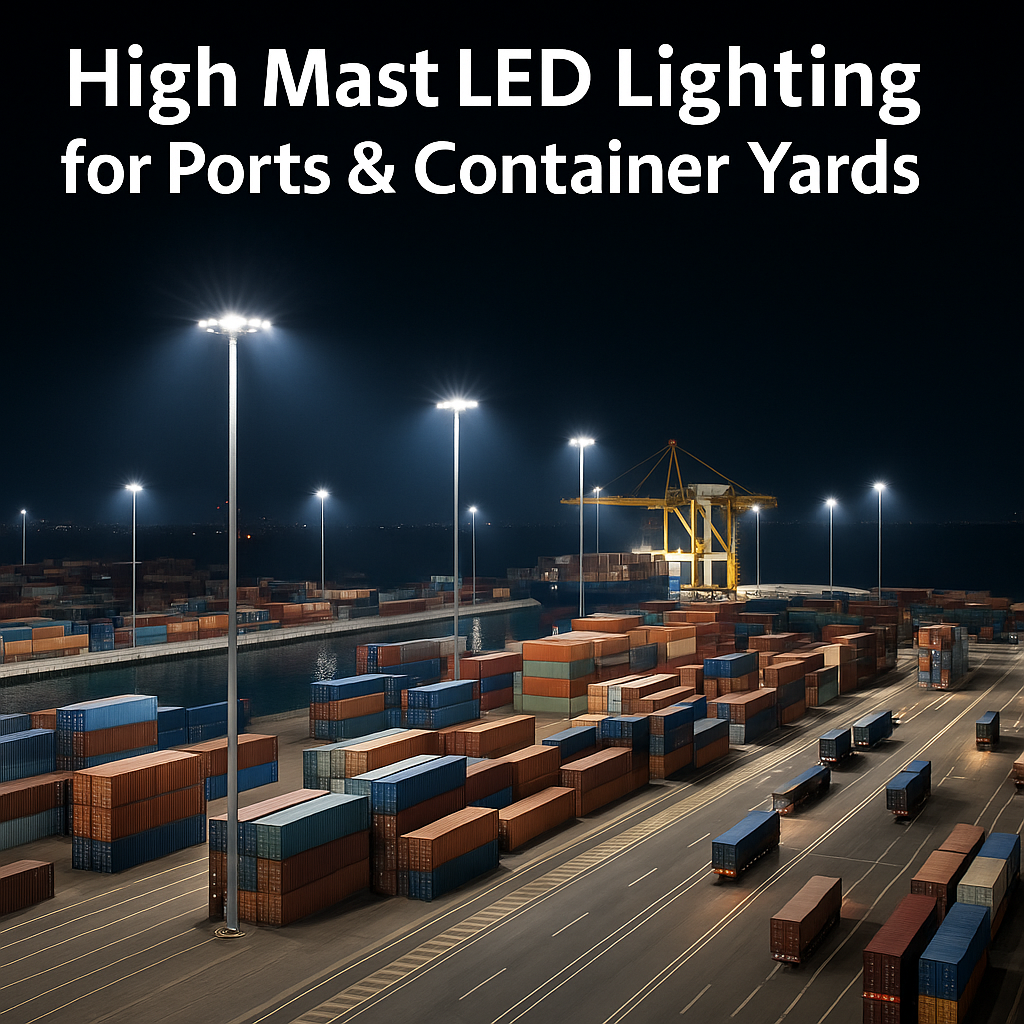
Ports, container yards and bulk terminals operate around the clock. Cranes, trucks, forklifts and people share the same busy space, often in difficult weather and at night.
In such environments, high mast lighting is not simply a convenience—it is a major safety system. Poor lighting can lead to accidents, cargo damage and delays. Traditional high-pressure sodium or metal halide systems consume a lot of energy and are expensive to maintain on very tall poles.
This is where high mast LED lighting has become the new standard. It can provide better visibility and uniformity while cutting both energy and maintenance costs.
Lighting Needs of Ports and Container Yards
Ports and container terminals have unique lighting challenges:
- Very large areas – container stacks, truck lanes, rail tracks, quay cranes
- Tall poles – 25–40 m high masts with 6–24 fixtures each
- Harsh environments – wind, dust, salt air, sometimes extreme temperatures
- Mixed tasks – container handling, paperwork, inspection, security
A good high mast lighting system must:
- Provide sufficient horizontal illuminance on traffic areas and working zones
- Deliver strong vertical illuminance so operators can see the sides of containers, markings and personnel
- Offer high uniformity – no dark pockets between stacks or masts
- Minimise glare for crane operators and drivers
- Maintain performance over a long lifetime with minimum downtime
Traditional systems with 1,000–2,000 W HID fixtures have difficulty maintaining these standards over time, especially as lamps age and color drifts.
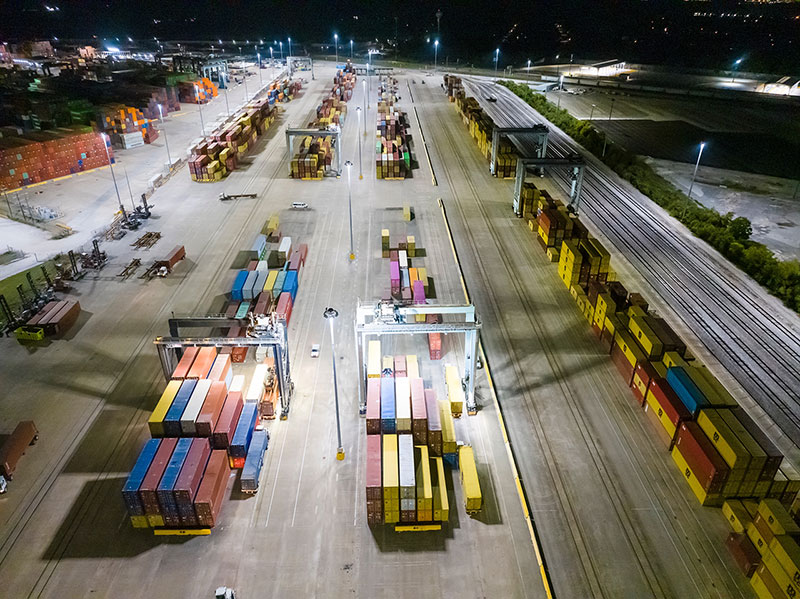
Designing High Mast LED Lighting for Ports
From an engineering point of view, high mast LED lighting must balance pole height, number of masts, quantity and wattage of fixtures, and beam optics.
1. Pole and Mast Configuration
- Typical heights: 25–40 m
- Common layouts:
- Masts positioned around the yard perimeter
- Masts placed at regular intervals between container stacks
- Special arrangements near quay cranes and ship berths
Higher poles allow larger coverage per mast but require narrower beam angles and robust structures to handle wind load.
2. LED Fixture Selection and Wattage
For ports and container yards,For ports and container yards, high mast LED floodlights in the 400–1,500 W range are commonly used.
Example configuration for one mast:
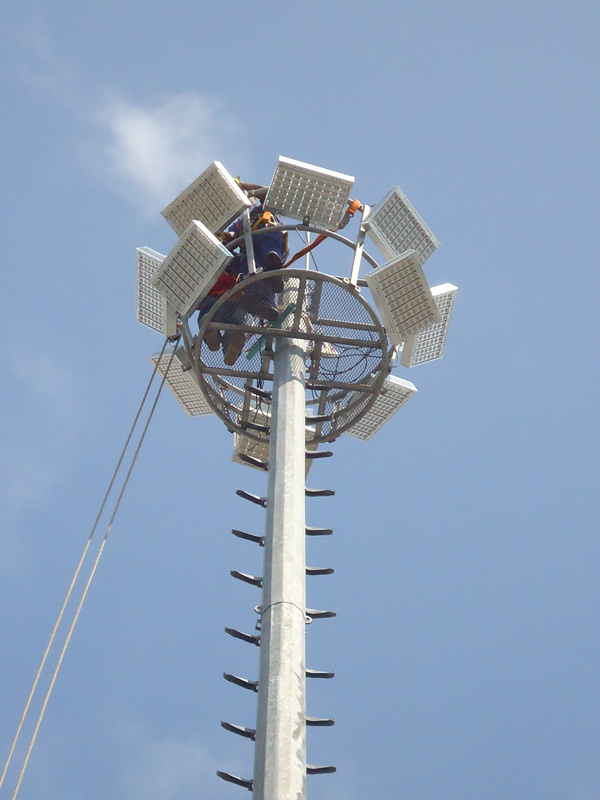
- 8 × 600–800 W LED flood lights at 30 m
- Mixed optics: narrow beams for long throws, medium beams for near areas
Compared with a conventional mast using 8 × 1,000–2,000 W HID fixtures, LEDs can reduce connected load by 40–60% while improving uniformity.
3. Optics and Aiming
Proper optics design is critical to avoid wasted light and glare.
- Narrow beam optics (for long distances) aim light between container rows and into truck lanes.
- Medium and wide beams cover areas closer to the mast and around intersections.
- Carefully designed tilt angles prevent direct exposure of LED chips to crane operators or truck drivers.
The goal is to create a carpet of light with smooth transitions and no dark gaps.
4. Environmental Protection and Durability
High mast fixtures must withstand:
- IP66 or higher protection against dust and heavy rain
- Corrosion-resistant housings and brackets for coastal environments
- High-quality surge protection for unstable power networks
- Thermal design suitable for both hot summers and cold winters
REITA’s experience in ports, steel plants and stadiums is directly applicable to ports and yards: modular heat sinks, separate driver boxes if needed, and robust mounting systems.
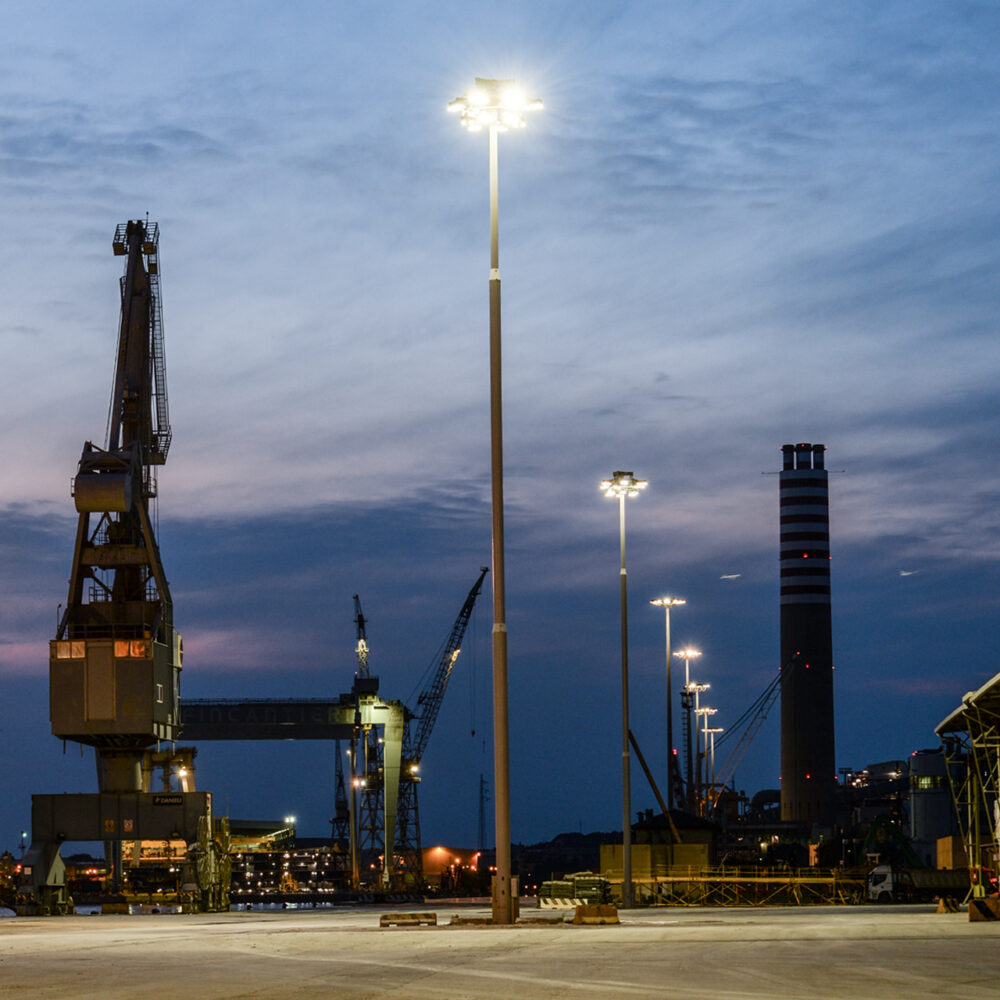
Case Example: Upgrading a Container Yard to LED High Mast Lighting
Consider a medium-size inland container yard that previously used:
- 12 high masts, each with 8 × 1,000 W metal halide flood lights
- Operating 10 hours per day, 365 days per year
- Electricity cost: $0.14 / kWh
Existing system
- Power per mast: 8,000 W
- Total power: 12 × 8,000 W = 96,000 W (96 kW)
- Annual energy: 96 kW × 10 h × 365 ≈ 350,400 kWh
- Annual energy cost: ≈ $49,056 / year
Maintenance included:
- Lamp replacement every 3–4 years (often done by batch on each mast)
- Ballast failures, requiring special trucks or cranes to reach the fittings
- Multiple nights of partial shutdowns during maintenance
LED high mast solution
- 12 masts, each retrofitted with 8 × 600 W LED modular flood lights
- New power per mast: 4,800 W
- Total power: 57.6 kW
- Annual energy: 57.6 kW × 10 h × 365 ≈ 210,240 kWh
- Annual energy cost: ≈ $29,434 / year
REITA modular LED flood lights can be configured with narrow and medium beams to cover both long throws and near areas.
Results
- Energy savings: ≈ $19,600 / year
- Illuminance improved from 30–60 lux (very uneven) to 80–120 lux with much better uniformity
- Color rendering significantly better; container markings and safety vests clearly visible
- Maintenance reduced to simple inspections; no regular lamp changes
If the LED upgrade (fixtures, labour, electrical work) costs about $200,000:
Simple payback ≈ 200,000 ÷ 19,600 ≈ 10.2 years on energy only.
Considering lower maintenance cost (fewer mast climbs, less labour and rental equipment), real payback time is typically 5–7 years, while safety and productivity improve immediately.
For a deeper explanation of running cost and simple payback, see our Running Cost of Stadium Lights & ROI Calculator guide.
You can adjust these numbers to match your own REITA port projects.
Case Study: High Mast LED Upgrade for a UK Port Yard
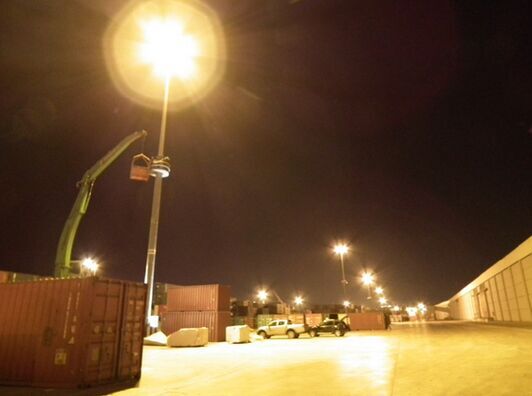
One real example comes from a container yard in the United Kingdom where REITA supplied high mast LED lighting.
The yard operates long hours at night and previously used high-pressure sodium fixtures mounted on tall masts. The old system created several problems:
- Yellowish light that made it hard to distinguish containers and markings
- Poor uniformity with dark pockets between stacks
- High maintenance cost, because every lamp change required a man-lift or climbing the mast
- Significant energy consumption
REITA provided a modular high mast LED solution using multiple LED floodlights on each mast head. The new system delivers:
- Bright, neutral-white light with much better visibility for drivers and crane operators
- More uniform lighting on container rows and truck lanes
- Greatly reduced maintenance – technicians now have far fewer trips up the mast
- Energy savings compared with the previous HPS installation
This UK port project shows how high mast LED lighting can modernise an existing yard without changing the mast locations, while improving both safety and operating cost.
Safety, Productivity & ROI
From management’s viewpoint, high mast LED lighting brings three major benefits.
- Safety
- Better visibility around stacking areas and truck lanes reduces collision risk.
- Operators see personnel and obstacles earlier.
- A well-lit yard also improves personal security and reduces theft.
- Productivity
- Crane operators and drivers can work faster and more accurately when they see clearly.
- Fewer lighting failures mean fewer delays and re-scheduling issues.
- Good lighting supports yard automation and camera systems.
- Cost and Sustainability
- Significant reduction in energy bills.
- Much lower cost of maintenance on tall masts.
- Lower CO₂ footprint supports green port initiatives and ESG reporting.
Because ports often run long hours, the financial and environmental benefits of LED are especially strong.
Share your yard layout, mast positions and current fixtures, and contact our team for a free high mast LED lighting proposal.
FAQ: High Mast LED Lighting for Ports & Yards
1) Can we mix LED and HID fixtures on the same mast during transition?
Technically it is possible, but not recommended long term. Mixed systems complicate maintenance and can create uneven light and color. Many operators upgrade mast by mast to keep consistency.
2) Will LED high mast lights create more glare for truck drivers?
Properly selected optics and aiming can reduce glare compared with old flood lights. During design, simulations should check both horizontal and vertical illuminance as well as predicted glare for key viewing positions.
3) How do we maintain LED fixtures at 30–40 m height?
Because LEDs require much less frequent intervention, many ports schedule maintenance every few years or when visual inspections identify an issue. Some projects use lowering systems; others use cranes or specialised trucks already available on site.
4) Are LED high mast lights suitable for cold or very hot climates?
Yes, as long as you choose fixtures with appropriate thermal design and driver specifications. REITA’s high mast LEDs are used in both hot industrial plants and cold outdoor environments.
5) Can we use lighting controls with high mast LEDs?
Yes. Dimming and zoning controls can further reduce energy use during low-activity periods. For example, you can run reduced levels in quiet zones and full output only where cranes are operating.

